Address: DeZhou,ShanDong,China | Whatsapp/Phone: +86-18653152590 | E-mail: aike0453@gmail.com


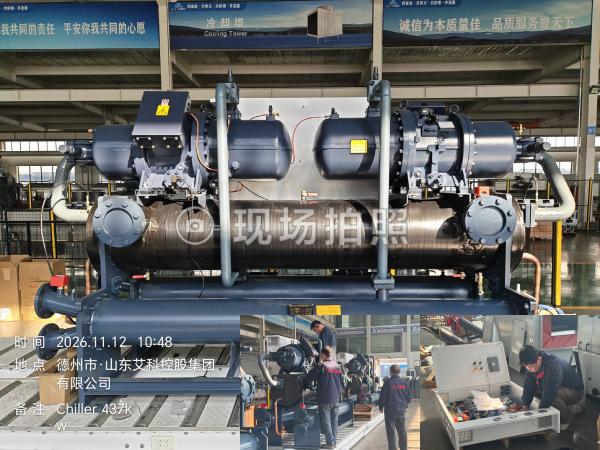
A custom chiller order for a Venezuelan industrial customer has completed the manufacturing phase and is now undergoing full performance verification at our factory. The units will not leave the floor until every critical parameter—cooling capacity, power draw, pressure integrity, and control response—has been measured and documented.
This is not a routine step we rush through. For buyers in Venezuela, where ambient temperatures can push cooling systems to their limits and spare parts logistics demand foresight, the factory test is the last clear opportunity to catch a problem before it crosses an ocean.
Every chiller we build goes through a structured verification protocol before crating. For this Venezuelan order, the following checks are being performed at design load conditions:
Cooling capacity and efficiency. The unit is run at its rated evaporator leaving water temperature and condenser entering conditions. We record the actual refrigeration tons delivered and calculate kW/ton or COP against the design specification. A chiller that passes visual inspection but fails to hit its capacity at design conditions is not a finished product.
Compressor and electrical performance. Full-load amperage, voltage balance across phases, and compressor operating pressures are logged. For export orders, we verify that the electrical configuration matches the destination market’s supply—Venezuela operates on 60 Hz, and voltage stability can vary by region, so this step is non-negotiable.
Pressure and leak integrity. The refrigerant circuit is pressure-tested and held to confirm no leakage. We also verify safety control setpoints: high-pressure cutout, low-pressure cutout, and flow switch response.
Control system sequence. The unit’s controller is exercised through startup, steady-state operation, and controlled shutdown. Alarm and fault codes are triggered deliberately to confirm they display and log correctly. For customers who will rely on remote troubleshooting, a controller that behaves predictably is as important as a compressor that runs efficiently.
Venezuela’s chiller market spans industrial process cooling, food and beverage, plastics, and petrochemical applications. Each sector imposes its own demands on a chiller—but all share a common constraint: once the unit arrives at a port and clears customs, resolving a manufacturing defect becomes a slow, expensive process involving international freight, customs formalities, and lost production time.
The Venezuelan climate adds another layer. Air-cooled chillers operating in high-ambient conditions need adequately sized condensers and fans that maintain airflow under sustained heat load. Our test protocol includes running the unit long enough to stabilize at thermal equilibrium, not just a brief startup check. A chiller that performs for ten minutes may behave differently after two hours at full load.
There is also a regulatory dimension. Venezuela has introduced energy efficiency requirements and restrictions on certain imported cooling equipment. While the specifics of enforcement can vary, we design and test to recognized performance standards so that documentation can be produced if requested at the port.
The test is only useful if the results travel with the equipment. Each chiller in this Venezuelan order will ship with:
A factory test report listing measured capacity, power input, and key operating pressures at the tested conditions
Electrical schematics and controller parameter records
A recommended spare parts list based on the specific components installed
Operation and maintenance documentation in English, with key safety points translated where helpful
We also photograph and document the crating process. Chillers are heavy, top-heavy, and sensitive to vibration. The Venezuelan order will be secured on reinforced bases, wrapped with corrosion inhibitor, and crated with clear handling markings. The customer receives images of the final packaging before the container doors close.
A chiller is a long-term asset, and the relationship does not end when the vessel sails. For this Venezuelan client, we have established a remote technical support channel and will provide startup guidance once the units are on site. The test data we are generating now becomes the baseline for future service—if the chiller behaves differently in Caracas than it did in our test bay, we have a reference point to diagnose why.
We do not claim that every unit will run flawlessly for a decade. We do claim that the units leaving our floor have been measured, challenged, and documented against the specification the customer agreed to. That is the standard we hold for every export order, including this one bound for Venezuela.
Sourcing chillers for a project in Venezuela or elsewhere in Latin America? Send us your cooling load, voltage requirements, and application details. We will respond with a specification proposal and a clear description of the testing protocol your order will undergo before shipment.
For inquiries or technical specs, contact our team.